2D Camera Management
The 2D Camera Management window is used to centrally manage all industrial 2D cameras in the system, providing access to device configuration and tuning before image acquisition.
In this window, you can perform the following operations:
-
Search and add multiple 2D cameras
-
Manage camera connection status (connection, disconnection, deletion, etc.)
-
Configure triggering method and connection parameters
-
Adjust image acquisition parameters and preview effects in real time
This window is primarily used for camera debugging during project preparation. After configuration, the camera can be used by the 2D Camera Step in a project workflow for image acquisition.
Start the Feature
You can use the following methods to open the 2D Camera Management window:
-
In the Step Parameters pane of 2D Camera, click the Camera management button to enter.
-
Select from the menu bar.
User Interface
The 2D Camera Management window consists of the following areas.
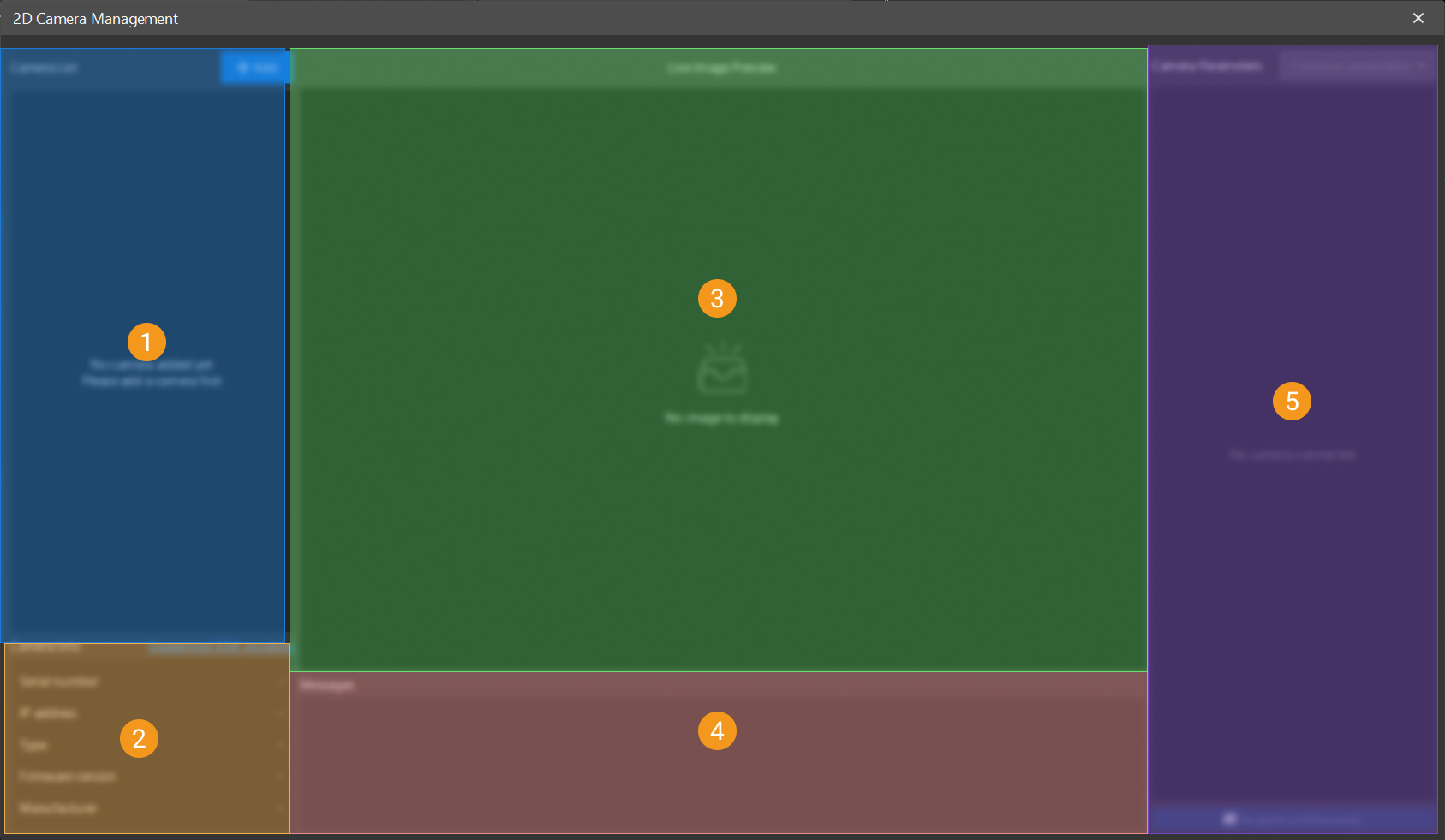
| No. | Area | Description |
|---|---|---|
① |
Camera list area |
Displays all added 2D cameras. You can add, connect, disconnect, rename, or delete cameras. |
② |
Camera information |
Displays the basic information of the selected camera, including serial number, IP address, firmware version, manufacturer, and type. |
③ |
Live image preview area |
Displays the acquired live images for debugging. |
④ |
Message box |
Displays the camera connection status, trigger information, and error messages. |
⑤ |
Camera parameter panel |
Configure the trigger and connection settings, image acquisition settings, and control the image acquisition status. |
Add Camera
In the camera list area, click the Add button to add a 2D camera in the following ways.
| Make sure that the SDK or configuring tool provided by the camera manufacturer (check the supported version) is installed on the same IPC so that the camera can be discovered by the software. |
-
Automatic search
The system will automatically scan the current network environment, search for available cameras on the same subnet, and list the search results. Applicable to most standard deployment scenarios.
-
Search by IP address
Supports adding devices by manually entering the camera IP address (except for Basler cameras).
Once added, the camera is set to connected by default. You can disconnect, rename and delete a camera in the Camera List.
Image Acquisition and Debugging Workflow
Follow the steps below to debug:
-
Add the camera and establish the connection.
-
Set the Data Acquisition Trigger Source parameter to Software.
-
Click the Acquire continuously button.
-
Ensure that the brightness, clarity, and orientation of the image are correct. If the results are not as expected, adjust Exposure Time, Gain, and the parameters related to Image Flip.
-
Switch the Data Acquisition Trigger Source to the external trigger mode.
Camera Parameter Description
|
Trigger and Connection Settings
Used to configure the data acquisition triggering method and connection behavior of the camera.
| Parameters | Description | ||
|---|---|---|---|
Enable heartbeat detection |
Once enabled, the system periodically monitors the camera connection status. If connection fails, the system automatically attempts to reconnect. The default value of Auto-reconnect attempts is 5; adjust it based on network stability. |
||
Data acquisition trigger source |
Set the data acquisition trigger source, such as software. Software is recommended for configuration. If using external, ensure the hardware wiring is correct. |
||
Max number of reconnections |
Set the maximum number of automatic reconnect attempts. If automatic reconnect attempts are too few, temporary losses of connection may not be recovered. If too many, connection timeout may be delayed. |
||
Trigger delay |
The delay in image acquisition after triggering. |
||
Buffer settings |
Used to configure the image buffer strategy. Visible only when Data Acquisition Trigger Source is set to External.
|
Image Acquisition Settings
Used to configure image quality parameters.
| Parameter | Description | ||
|---|---|---|---|
Exposure Time |
Specifies the exposure duration for a single frame. In dark conditions, increase the exposure time; in bright conditions, decrease it.
|
||
Gain |
Amplify image signals. Excessive gain amplifies noise. Increase gain only when exposure cannot provide required brightness. |
||
Gamma Correction |
Specifies a non-linear correction applied to image brightness, typically used for display optimization. Enable it with caution. After enabling it, you need to set the gamma value. |
||
Horizontal flip |
Flips the image horizontally. |
||
Vertical flip |
Flips the image vertically. |
||
Image Width |
The width (in pixels) of the captured image, defined relative to the image center. |
||
Image Height |
Height (in pixels) of the captured image, defined relative to the image center. |
After adjusting the parameters, click the Acquire continuously button in the lower-right corner and see the result in the live image preview area. If the image does not meet expectations, click the Stop acquisition button and continue adjusting the parameters until the desired result is achieved.
Troubleshoot
Any Camera Cannot Be Found in the Automatic Search Window
Symptom:
Cameras could not be automatically discovered in the Add Camera window.
Possible Causes:
-
The camera is not on the same subnet as the IPC.
-
The camera is not powered on or the Ethernet cable is disconnected.
-
The corresponding camera plugin is not enabled.
-
The camera is occupied by other software.
Solutions:
-
Check whether the IP addresses of the camera and the IPC are on the same subnet and adjust the network settings.
-
Confirm that the camera is powered on and make sure that the Ethernet cable is securely connected.
-
In the menu bar, select , make sure that the corresponding camera plugin is enabled, and restart the software. Note that enabling the camera2d_bsl plugin may prevent DAHENG IMAGING and Hikvision cameras from being detected.
-
Close other software that may occupy the camera. Ensure the camera is idle, then search again.
Connected but No Image
Symptom:
The camera is connected, and after clicking the Acquire continuously button, the live image is blank or black.
Possible Causes:
-
The Data acquisition trigger source is incorrectly configured.
-
If the Data acquisition trigger source is correctly configured, the external signal may not be connected.
-
The exposure time is too short, resulting in black images.
Solutions:
-
Make sure the Data acquisition trigger source matches the actual acquisition method (software or external).
-
If using external, ensure that the trigger cable is correctly connected and receives a valid signal input.
-
Adjust the Exposure time to achieve proper image brightness. If necessary, increase the Gain while avoiding excessive noise.
Excessive Image Noise
Symptom:
Captured images exhibit significant noise and a grainy appearance, which can affect detection or measurement effect.
Possible Causes:
-
The Gain value is set too high.
-
Insufficient ambient light.
Solutions:
-
Increase the intensity of the light source first to enhance the overall image brightness.
-
Increase the exposure time to allow more light to be captured by the sensor.
-
If the issue persists, decrease the Gain setting appropriately.