Create Line (2D)
Description
This Step is used to create 2D lines based on geometric features such as points and lines.
Usage Scenario
This Step is commonly used to generate feature lines for measurement assistance or as fundamental data for subsequent geometric calculations.
Workflow
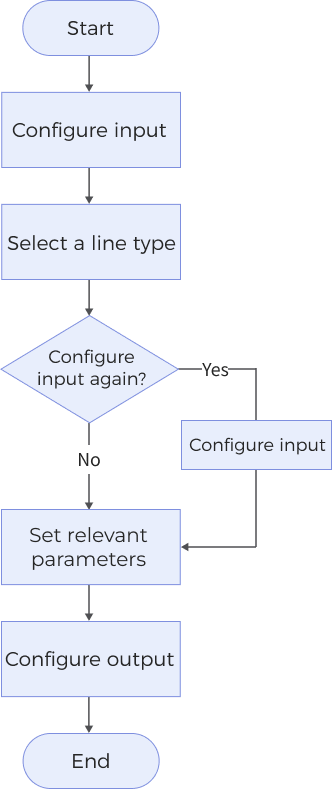
The process of configuring this Step is shown below:
-
Configure the input. Connect the ports manually in the graphical programming workspace or select the input under Input in the parameter configuration panel.
-
In the Parameters section, select the Line Type to determine how a line is generated, and choose the corresponding input data in the Input section.
-
If there are additional parameters in the Parameters section, select and adjust them according to your actual needs.
-
Select the desired output items under Output. For an expandable output item, click ▶ and configure the Lower limit and Upper limit values to set the acceptable range.
Parameter Description
Line Type
The method to create a line.
For different types of lines, the geometric features input into the Step and the parameters that need to be adjusted will vary accordingly. The specific correspondences are as follows:
| Line Type | Geometric Features to be Input | Parameter Adjustment |
|---|---|---|
Constant Line (Custom) |
- |
You need to set the coordinates of two constant points in the Parameters section. After the Step is run, it outputs the line connecting the two points. |
Given Line |
Point 1, Point 2 |
After the Step is run, it outputs the line connecting the two points. No other parameters need to be adjusted. |
Parallel Line from Point and Line |
Point, Line |
After the Step is run, it outputs a line that passes through the given point and is parallel to the given line. No other parameters need to be adjusted. |
Rotate Line around Point |
Point, Line |
You need to set the Rotation Angle of the line around the point. After the Step is run, it outputs a line that rotates around a given point by a specified angle. |
Constant Line (Step input) |
Line |
After the Step is run, it outputs the constant line. No other parameters need to be adjusted. |
Output Description
Select the output item(s) to add the output port(s) to the Step, and the corresponding data will be output after the Step is run. You can select the output according to the actual measurement requirements.
|
If you select an expandable output item, you should expand it by clicking ▶, and then set the Lower limit and Upper limit values to determine the acceptable range. If the output value falls within the acceptable range, the measurement item is judged as passing (OK), or else it is judged as failing (NG). |
| Output item | Description |
|---|---|
Created Line |
The line created from the selected line type can serve as an input for other steps. |
Point X |
The X value of a point on the line. |
Point Y |
The Y coordinate of a point on the line. |
Line Angle |
Angle between the line and the positive X-axis. |
Troubleshooting
|