样例程序17:MM_S17_Vis_ParseLabel
程序解读
以下为MM_S17_Vis_ParseLabel样例程序的代码及相关解释说明。
| 与MM_S1_Vis_Basic样例相比,本样例仅新增了解析标签的功能(加粗部分的代码)。因此,下文不再重复解释与MM_S1_Vis_Basic样例相同部分的代码(详情请参考MM_S1_Vis_Basic样例说明)。 |
   1:  !-------------------------------- ;
   2:  !FUNCTION: trigger Mech-Vision ;
   3:  !project and get vision result, ;
   4:  !then parse the label info ;
   5:  !Mech-Mind, 2023-12-25 ;
   6:  !-------------------------------- ;
   7:   ;
   8:  !set current uframe NO. to 0 ;
   9:  UFRAME_NUM=0 ;
  10:  !set current tool NO. to 1 ;
  11:  UTOOL_NUM=1 ;
  12:  !move to robot home position ;
  13:J P[1] 100% FINE    ;
  14:  !initialize communication ;
  15:  !parameters(initialization is ;
  16:  !required only once) ;
  17:  CALL MM_INIT_SKT('8','127.0.0.1',30000,5) ;
  18:  !move to image-capturing position ;
  19:L P[2] 1000mm/sec FINE    ;
  20:  !trigger NO.1 Mech-Vision project ;
  21:  CALL MM_START_VIS(1,0,2,10,53) ;
  22:  !check whether vision project has ;
  23:  !been triggered successfully ;
  24:  IF (R[53]<>1102),JMP LBL[99] ;
  25:  !get vision result from NO.1 ;
  26:  !Mech-Vision project ;
  27:  CALL MM_GET_VIS(1,51,53) ;
  28:  !check whether vision result has ;
  29:  !been got from Mech-Vision ;
  30:  !successfully ;
  31:  IF R[53]<>1100,JMP LBL[99] ;
  32:  !save first vision point data to ;
  33:  !local variables ;
  34:  CALL MM_GET_POS(1,60,70,80) ;
  35:  !parse label info received from ;
  36:  !Mech-Vision, eg. "R[70]=56" ;
  37:  !will decompose into 5 and 6 ;
  38:  R[30]=R[70] DIV 10    ;
  39:  R[31]=R[70] MOD 10    ;
  40:  !add handling logic according to ;
  41:  !decomposed label value ;
  42:  IF (R[30]=5) THEN ;
  43:  !add handling logic a ;
  44:  PAUSE ;
  45:  ELSE ;
  46:  !add handling logic b ;
  47:  PAUSE ;
  48:  ENDIF ;
  49:  !move to intermediate waypoint ;
  50:  !of picking ;
  51:J P[3] 50% CNT100    ;
  52:  !move to approach waypoint ;
  53:  !of picking ;
  54:L PR[60] 1000mm/sec FINE Tool_Offset,PR[1]    ;
  55:  !move to picking waypoint ;
  56:L PR[60] 300mm/sec FINE    ;
  57:  !add object grasping logic here, ;
  58:  !such as "DO[1]=ON" ;
  59:  PAUSE ;
  60:  !move to departure waypoint ;
  61:  !of picking ;
  62:L PR[60] 1000mm/sec FINE Tool_Offset,PR[1]    ;
  63:  !move to intermediate waypoint ;
  64:  !of placing ;
  65:J P[4] 50% CNT100    ;
  66:  !move to approach waypoint ;
  67:  !of placing ;
  68:L P[5] 1000mm/sec FINE Tool_Offset,PR[2]    ;
  69:  !move to placing waypoint ;
  70:L P[5] 300mm/sec FINE    ;
  71:  !add object releasing logic here, ;
  72:  !such as "DO[1]=OFF" ;
  73:  PAUSE ;
  74:  !move to departure waypoint ;
  75:  !of placing ;
  76:L P[5] 1000mm/sec FINE Tool_Offset,PR[2]    ;
  77:  !move back to robot home position ;
  78:J P[1] 100% FINE    ;
  79:  END ;
  80:   ;
  81:  LBL[99:vision error] ;
  82:  !add error handling logic here ;
  83:  !according to different ;
  84:  !error codes ;
  85:  !e.g.: status=1003 means no ;
  86:  !point cloud in ROI ;
  87:  !e.g.: status=1002 means no ;
  88:  !vision results ;
  89:  !e.g.: mm_status=3099 means ;
  90:  !failed to open socket ;
  91:  PAUSE ;
上述样例程序代码对应的流程如下图所示。
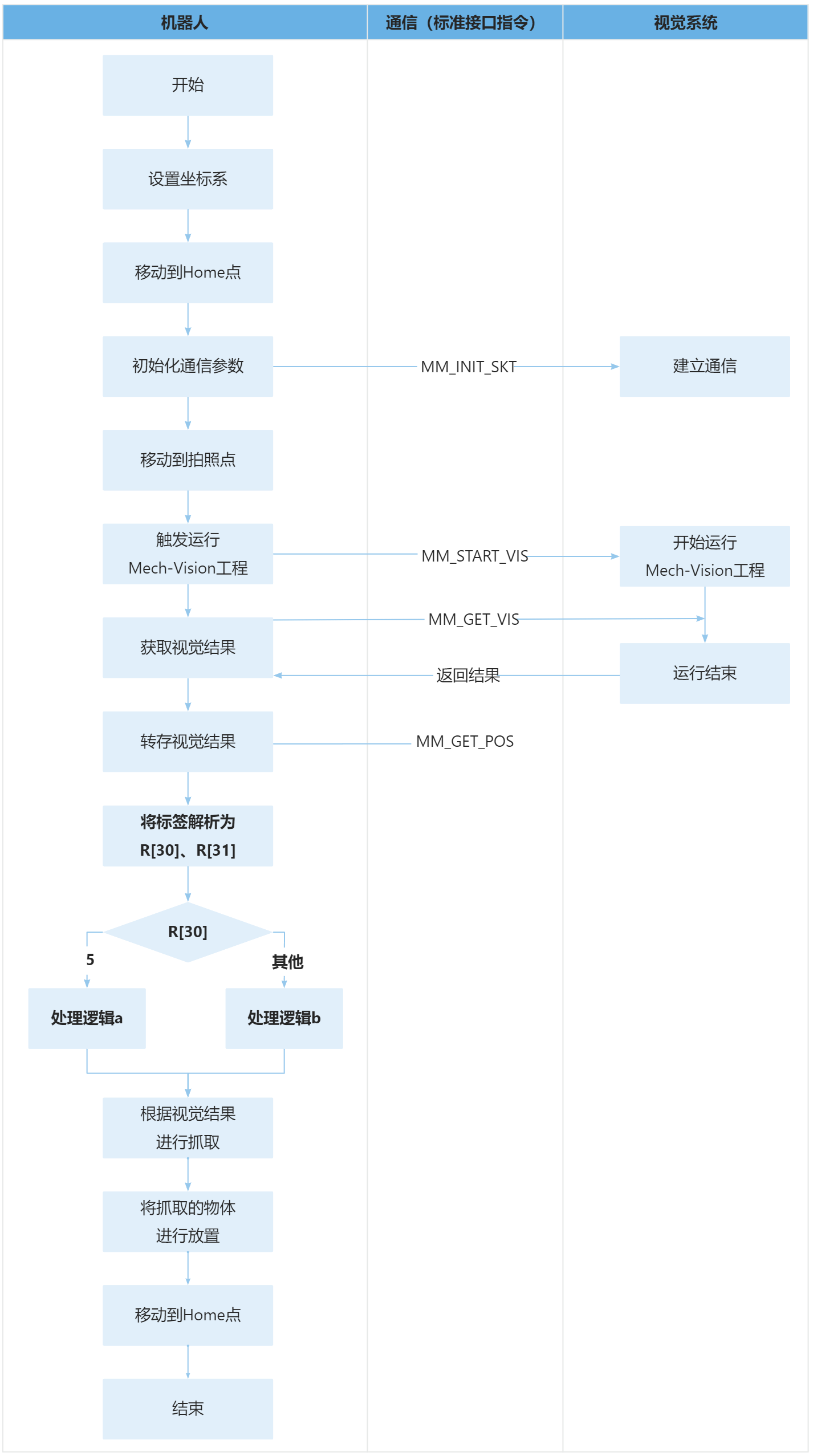
下表为解析标签的逻辑解读。用户单击指令名称的超链接便可查看该指令的详细说明。
| 流程 | 代码及说明 |
|---|---|
将标签解析为R[30]、R[31] |
MM_GET_POS指令可以将某个视觉点的工具位姿、标签和末端工具编号分别转存至PR[60]、R[70]、R[80]中。本样例假设R[70]的值为56,“R[70] DIV 10”表示56整除10的商(即为5),“R[70] MOD 10”表示56整除10的余数(即为6),如此便将56解析成5和6。 |
根据解析后的标签值添加处理逻辑 |
上述代码表示,如果R[30]为5,则执行处理逻辑a;否则,执行处理逻辑b。用户可根据具体业务场景,针对不同的标签值,添加不同的处理逻辑。 |