Imaging Mechanism of Structured-Light Camera
Mech-Eye Industrial 3D Camera (“3D camera” for short) is a structured-light 3D camera. Based on the projection method used, structured-light cameras can be classified into two types: area-scan structured-light cameras and line-scan structured-light cameras.
-
An area-scan structured-light camera projects a structured-light pattern onto the surface of an object and calculates depth information from the acquired images to generate a 3D point cloud. Cameras in the DEEP, LSR, PRO, NANO, ULTRA M, and UHP-140 series are examples of this type.
-
A line-scan structured-light camera scans an object’s surface line by line by controlling the scanning direction of a laser line and generates a 3D point cloud from the acquired profile data. The Range series, such as Range XL, is an example of this type.
Area-Scan Structured-Light Camera
An area-scan structured-light camera consists of a 2D camera and a projector. The projector projects a structured-light pattern, such as a stripe pattern, onto the target object’s surface, and the 2D camera acquires images of the object. Based on the imaging characteristics of the structured-light pattern on the object’s surface, the camera calculates the depth at each position within its field of view to generate a 3D point cloud. The camera can also capture 2D images of the target object.
The entire scanning process of an area-scan structured-light camera can be divided into three phases: data acquisition, calculation and processing, and output. The following sections describe each phase.
Data Acquisition
An area-scan structured-light camera can acquire both 2D and 3D data of a target object.
-
Process of acquiring 3D data:
-
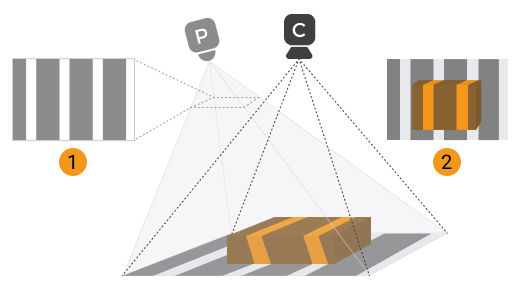
The projector (P in the figure below) projects a stripe pattern (① in the figure below) onto the surface of the target object. The shape of the target object distorts the stripe pattern.
-
The 2D camera (C in the figure below) acquires an image (② in the figure below) containing the distorted stripe pattern and the target object.
-
The projector continues to project structured light of different patterns, and the 2D camera continues to capture images for each light pattern.
-
-
Process of acquiring 2D data: When the projector is not projecting structured light, the image acquired by the 2D camera is the 2D image of the target object.
Calculation and Processing
The area-scan structured-light camera calculates depth data for the object’s surface based on distortions in the projected stripe pattern. The depth data is then further processed to generate a depth map and a point cloud.
Output
The area-scan structured-light camera outputs the generated data to Mech-Eye SDK or the GenICam client, allowing users to obtain the 2D image, depth map, and point cloud.
-
2D image: the image acquired by the 2D camera when the projector is not projecting structured light.
-
Depth map: an image containing depth information.
-
Point cloud: a collection of points on an object’s surface, each represented by 3D coordinates (X, Y, and Z).
Line-Scan Structured-Light Camera
A line-scan structured-light camera consists of an imaging unit and a laser projector. The laser projector projects a laser line onto the target object’s surface. A galvanometer scanner deflects the laser line to scan the entire field of view line by line. Two image sensors, positioned on the left and right, acquire images of the laser line at each scan position from different viewing angles. Using the principle of laser triangulation, the camera calculates the depth information of the object’s surface and captures a 2D image of the target object.
The entire scanning process of a line-scan structured-light camera can be divided into three phases: data acquisition, calculation and processing, and output. The following sections describe each phase.
Data Acquisition
A line-scan structured-light camera can acquire both 2D and 3D data of a target object.
-
Process of acquiring 3D data:
-
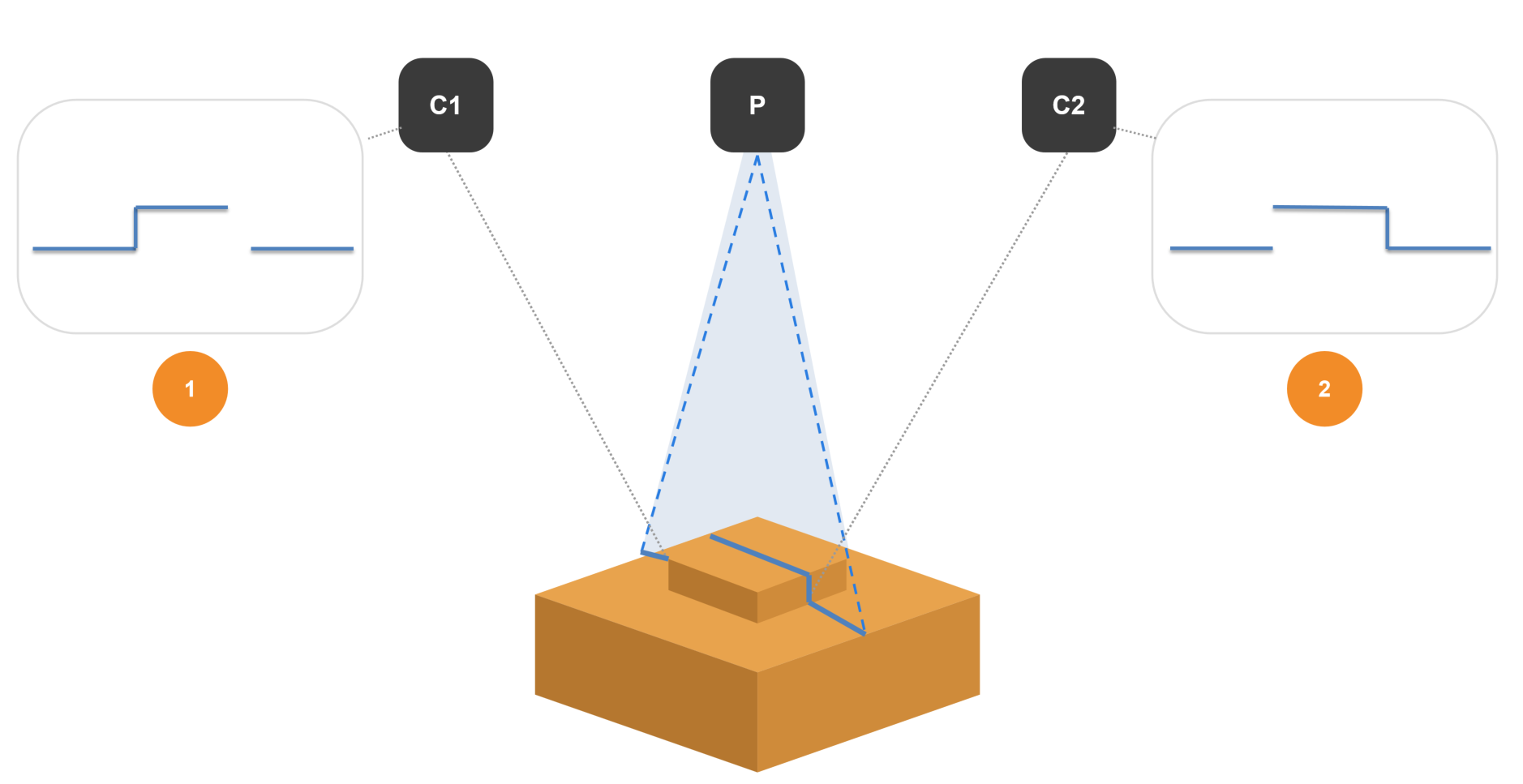
The laser projector (P in the figure below) projects a laser line onto the target object’s surface. The shape of the target object distorts the laser line.
-
A galvanometer scanner (oscillating mirror) directs the laser line across the entire field of view, one line at a time. At each scan position, the two image sensors on the left and right (C1 and C2 in the figure below) each acquire an image containing the distorted laser line, as illustrated in ① and ② below.
-
The galvanometer scanner continues to oscillate until the laser line has scanned the entire field of view, allowing the camera to acquire a series of laser-line images. No relative motion between the camera and the object is required during this process.
-
-
Process of acquiring 2D data: When the laser projector is not projecting laser light, the image captured by the imaging unit is the target object’s 2D image.
Calculation and Processing
The line-scan structured-light camera calculates depth data for the object’s surface based on the distortion of the laser line. The depth data is then further processed to generate a depth map and a point cloud.
Output
The line-scan structured-light camera outputs the generated data to Mech-Eye SDK or the GenICam client, allowing users to obtain the 2D image, depth map, and point cloud.
-
2D image: The image captured by the imaging unit when the laser projector is not projecting a laser line.
-
Depth map: an image containing depth information.
-
Point cloud: a collection of points on an object’s surface, each represented by 3D coordinates (X, Y, and Z).